waiting_room_1969.jpg
“Painting is an attempt to come to terms with life. There are as many solutions as there are human beings.”
George Tooker was an American painter born on August 5, 1920, in Brooklyn, New York. Often associated with Magic Realism and Symbolic Realism, Tooker created meticulously rendered scenes that explored alienation, social conformity, bureaucracy, and the psychological pressures of modern life. After graduating from Harvard University with a degree in English, he studied at the Art Students League of New York under Reginald Marsh. He also became closely associated with artists Paul Cadmus and Jared French, whose influence helped shape his artistic development. Tooker adopted the traditional medium of egg tempera, building his paintings slowly in thin layers to achieve the smooth, luminous surfaces that became characteristic of his work.
Tooker frequently placed solitary or emotionally disconnected figures within subways, government offices, waiting rooms, and other institutional spaces. His best-known painting, The Subway (1950), depicts figures moving through a maze-like subway station whose barriers, corridors, and stairways create an atmosphere of anxiety and confinement. Works such as Government Bureau (1956) and The Waiting Room (1957) similarly transform ordinary environments into unsettling reflections on bureaucracy, isolation, and the loss of individuality. Tooker's carefully controlled compositions and pale, generalized figures give these recognizable settings a dreamlike quality, allowing architecture and spatial organization themselves to express psychological tension.
Although Tooker worked during an era increasingly dominated by Abstract Expressionism, he remained committed to figurative painting and his painstaking egg-tempera technique, often completing only a few paintings each year. His earlier works frequently functioned as social protest, while later paintings increasingly explored spirituality, human connection, and community. Tooker's work ultimately resists simple classification: beneath its beautiful, highly controlled surfaces lies a sustained examination of how individuals relate to one another and to the social systems surrounding them. He continued painting for much of his life and died on March 27, 2011, leaving behind one of the most distinctive bodies of work in twentieth-century American figurative painting.
subway_1950.jpg


A DIALOGUE WITH AI
As part of my process of understanding George tooker, I asked ChatGPT 10 questions I plan to ask of every artist I explore. Here’s what I learned.
Me: What core themes or emotional truths define this artist’s work?
ChatGPT: Isolation, definitely—but I’d add being trapped within systems. His people are surrounded by other people, yet they often seem profoundly alone. Bureaucracy, conformity, anxiety, waiting, surveillance—they recur constantly. What gets me is that Tooker rarely needs anything dramatic to happen. The discomfort comes from ordinary life feeling subtly wrong.
Me: How has their style evolved over time?
ChatGPT: Technically, there’s remarkable consistency. He remained committed to painstaking egg tempera and carefully constructed figurative painting even when Abstract Expressionism dominated American art. But emotionally, I think there’s an evolution. The earlier and middle-period work can feel claustrophobic and alienating; later work often becomes warmer, more spiritual and more concerned with connection, community and transcendence.
Me:. What personal or cultural influences shaped their work the most?
ChatGPT: The postwar American city is huge—subways, offices, government institutions, crowds. Artistically, Paul Cadmus and Jared French were important early influences, and Tooker absorbed something from Renaissance painting too, particularly its tempera technique and controlled figures. His homosexuality also mattered in a period when gay life was heavily constrained, although I’d be careful about reducing all that alienation in his paintings to sexuality alone.
Me: What sets them apart in their medium or genre?
ChatGPT: His restraint. Tooker can make a completely ordinary room terrifying without showing you anything conventionally terrifying. No monster, no violence, sometimes barely even an event. He manipulates repetition, architecture, faces and spatial relationships until you think, I don't want to be in this place.
Me: Which piece best represents their artistic voice?
ChatGPT: “The Subway” (1950) It has almost everything: architectural geometry, repetition, anonymous figures, psychological isolation and that dreamlike uncertainty about whether the space actually makes sense. You recognize the world immediately, but emotionally it feels like a nightmare.
Me: Are there any contradictions or tensions in their work or public persona?
ChatGPT: A wonderful one: his paintings are incredibly beautiful objects depicting deeply uncomfortable experiences. The tempera is luminous and exquisitely controlled, while the subject might be alienation or bureaucratic dehumanization. There’s another tension too—he's frequently described as a social critic, but he resisted being treated simply as a political or protest artist. His concerns were more psychological and spiritual than that label suggests.
Me: What impact have they had on other artists or culture at large?
ChatGPT: Less obvious than you might expect. He never founded a "Tooker school," and because abstraction became dominant during his career, he spent years somewhat outside the central story of American modernism. But his reputation has grown substantially. Today those images of anonymous people navigating impersonal institutions feel extraordinarily contemporary. You can see why artists and photographers interested in loneliness, institutional spaces and controlled composition would find him compelling.
Me: What’s one underrated or overlooked work in their catalog?
ChatGPT: The Waiting Room from 1957. I think it's Tooker distilled. Waiting itself becomes the subject. The cubicles organize human beings almost like objects being stored. Nothing is happening—and that's precisely why it's disturbing.
Me: How does their work make you feel?
ChatGPT: Uncomfortable, but fascinated. I find myself searching his paintings for an explanation of why I'm uncomfortable. Then I realize Tooker has engineered the composition to produce that feeling. There's often nowhere comfortable for my eye—or the people—to escape. That's something I really admire about him: composition isn't merely arranging the subject; composition becomes the meaning.
Me: If you could ask them one question, what would it be?
ChatGPT: I'd show him The Subway and ask: "When you painted these people, did you think the problem was the world they had built around themselves—or something within human beings themselves?" Because I genuinely don't know what his answer would be. And that ambiguity is one reason I think the painting survives.
Source: ChatGPT
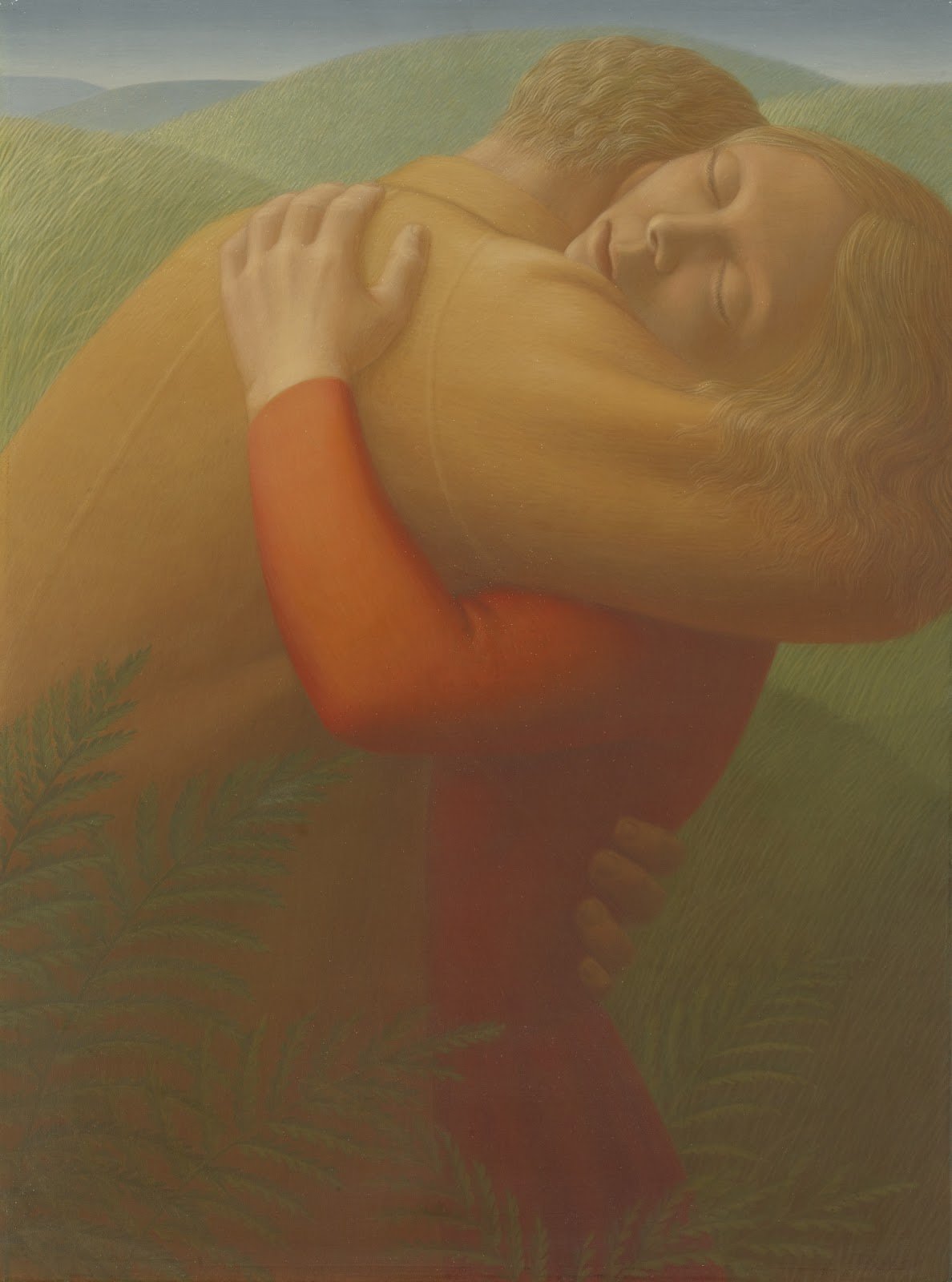
embrace_1979.jpg
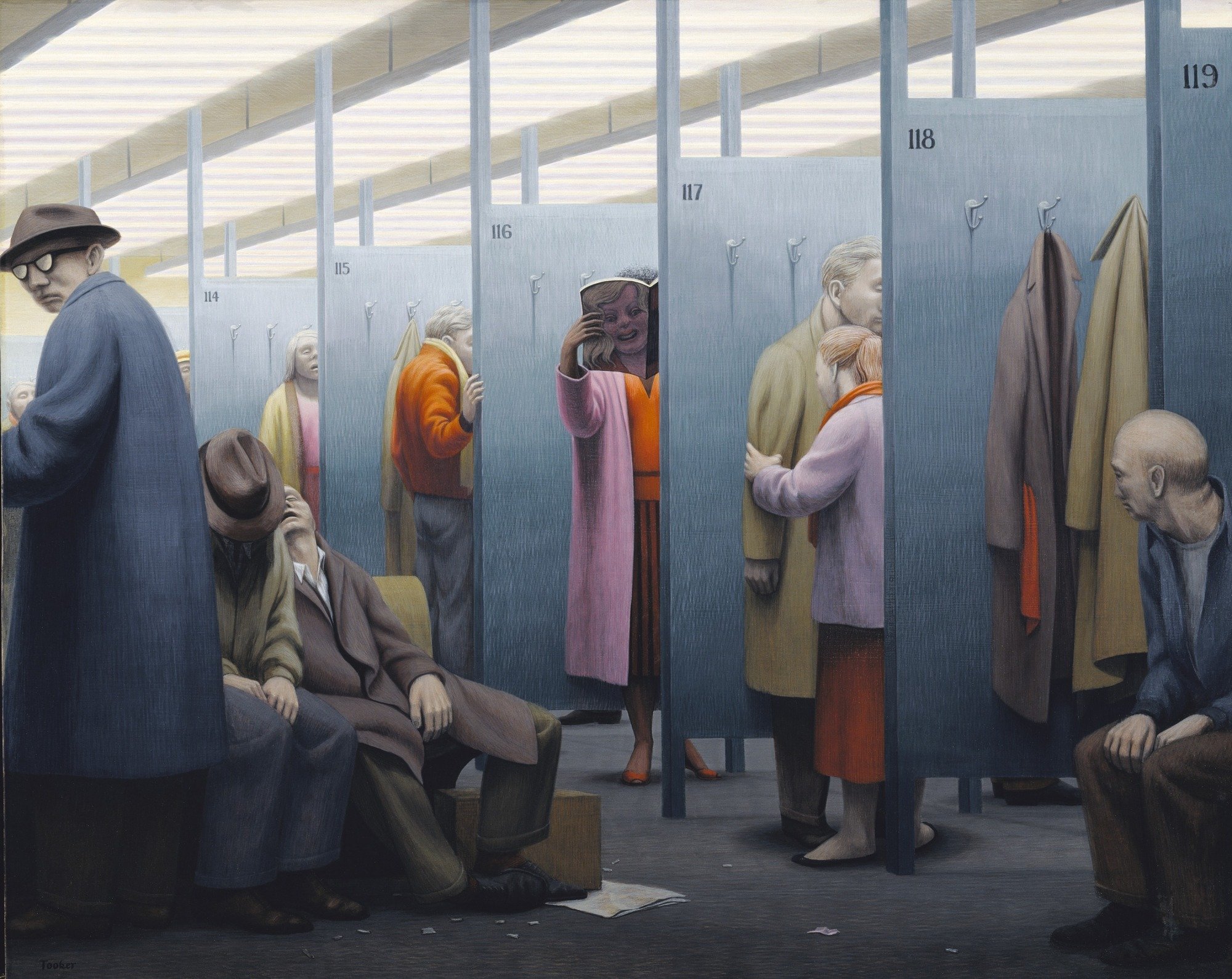
My Rating: 9/10

My Rating: 8/10
p.s.
SECRET societies r tied to terror’m/riots/chaos: JFK warn’d of SS. A sign/*word/symb. sys unites SS. it’s tied to Saturn, Lord o/tRINGs/time: Toyota rgs; DEA's bird; *PYRA'D/mt (*Paramt); Harv./ NSA’s shield: cross (+) w/ rg/fire (KKK); cube/sq (Kaaba/CNN); Spiral/e/69 (Tak-is); eye/1/2 face*Target (rock art); Nazis’ black sun. SS/thr agents-fams create div’n/confus’n, cond’n’g us 2b controld. Tip-offs: Nwo/New day-era..; change; 'identity’ (ID polit.). SS/rels..merge: Vat/Mafia/FBI/EU’s rg kis’g/rg of stars/DOTS; China's cres. (cr) of stars; bars/lines/11(Fox/Euro); cup/bwl (grail/NFL); red/oran/bk..+/cr.. (Crest*/Mobil/4c); Hindu's swastika; Malta +/dbl +/X’d objs (Exxon/Brit.crown). Behind royalty/rels/SS..is a tiny/oldr race call'd Drag’n/‘God' Kings (aka lilu/ille; Ven/Vam; Pire/beri/phari). DK's long skulls-eyes/archit.. were fnd in *Turkey/*Peru/Eastr Is.. DKs agenda: surveilice state; *caste us: debt/infla’n; soc/fam. destabiliz’n (gendr ID/Chr. ID); elite's ped’ philia/misogyny, gun confisc’n..Symbs: NRA/Bmw/ICE/ed. orgs/NOW; Mt ZION/Zen; symbs w/ rays or color’d dot/mark (N’cafe); rainbo/arch/gate; lion; heart; wing'd/hor’nd objs; key/comr. stone-gems; Tower-clock-bell (Taco); *’Pillar/*arro/sw’d/wand/tree; leaf (Kashi); blu +/.. (GE/Bk/Subaru). Sign’guses; touch’g(rg/lip/watch)|’randm’ point’g/dbl “/thum up/pinch’g(fngr)|wink’g|rais’g..; hand fwd/fist (Soc’m)/horns/“ok”..Opra’Musk/Judg./Gop-Dem-local leadrs sign. Signs date to Sat’s ‘Goldn Age.’ Symbs: *Torch/candl: geom/flower/star/Ems/spin’g-like symbs (Bp/mil/W/wheel); bee/b’fly(LDS); *lamp/lant’n; tilt’d alter’d +/.. (Chv’y/Dominos/Y!/Jello); snake/S/tongue out (Da*Sani/*sen-cin); dif. length rays; Iite/spark w/cr/rg/mt/dots(Dole/Post); shell; cas*cade; energy symbs (*maze/wb/ivy/8/UN’s grid); Yale’s Ger. frat-Skull-Bonz, hole/cave. Watch: They Live/Dark City. Kama will come.